
Closed cell vs open cell, explained
Spray Foam Insulation in Levittown, PA
Two foams, two jobs. We pick for each surface and show you why in writing.
- Free on-site estimates
- Written quote listing material, depth and R-value for each area
- Air leaks and moisture checked before anything gets covered
Choosing the Right Foam for Each Part of the House
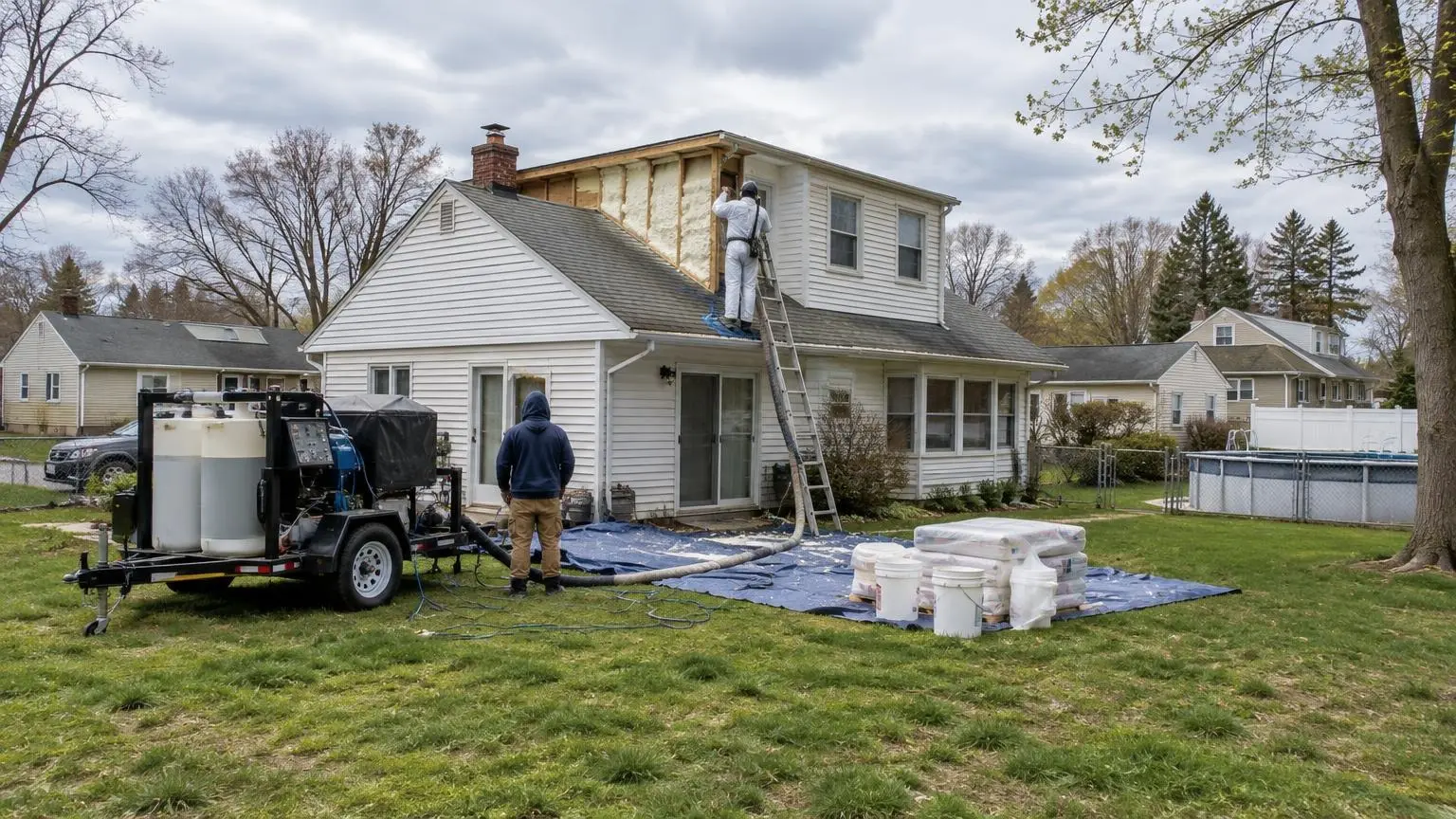
Spray foam insulation is a two-part liquid sprayed onto framing, roof decks or walls, where it expands and cures into a solid layer that both insulates and seals air leaks. Levittown homes are a good fit for it in specific places: low-slope roofs over back additions, cathedral ceilings in raised or expanded houses, floors over garages and porches, and the rim areas of houses in the older river towns that have basements. In those spots, foam does in one step what would otherwise take insulation plus a separate air barrier.
Open-cell foam
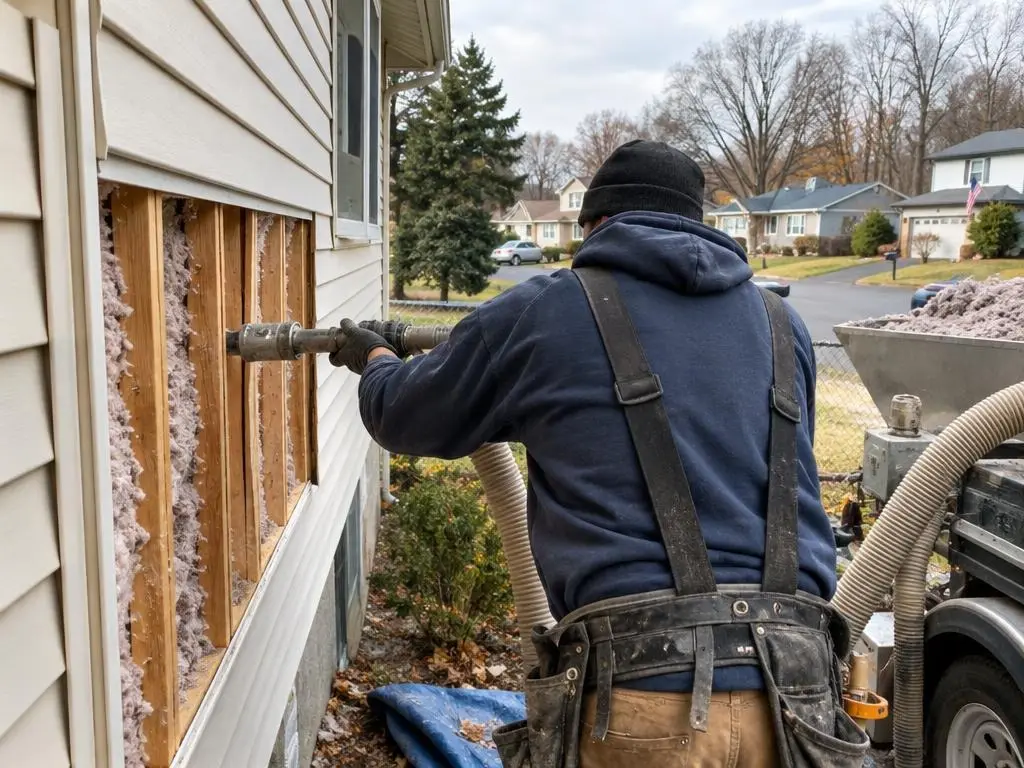
Open-cell foam is soft and sponge-like when cured. It expands a lot, which lets it fill cavities with wires, pipes and odd angles. HomeGuide lists it at R-3.5 to R-3.7 per inch and $1.50 to $3.50 per square foot installed. It blocks air very well, and it also dampens sound, which homeowners notice in bedrooms and home offices. Because some water vapor passes through it, it needs the right setting: interior walls, above-grade wall cavities with a vapor retarder in place, and some unvented roof assemblies when the design calls for it.
Closed-cell foam
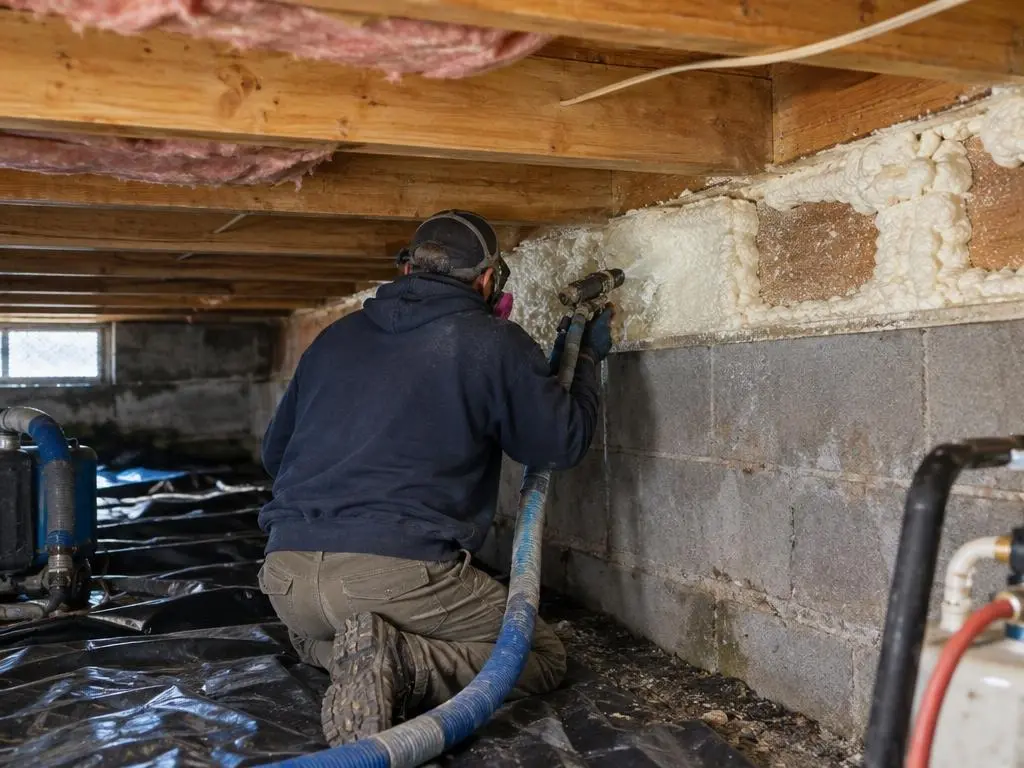
Closed-cell foam is dense and rigid, rated R-5 to R-7 per inch and priced around $3.00 to $5.00 per square foot (HomeGuide). It adds racking strength to the framing it bonds to, and at typical thickness it acts as a vapor retarder. Where depth is limited, such as a 2x6 rafter in a low-slope addition, closed-cell reaches a higher R-value than anything else that fits. It is also the usual choice anywhere near moisture: rim joists, crawl space walls, and the underside of floors exposed to outdoor air.
Where we use each in Lower Bucks County
Levitt-era houses were finished in a few short years and expanded one owner at a time. A typical project mixes spaces: an original attic that needs sealing and depth, a dormer or second-floor addition with kneewalls, and maybe a family room addition on a slab with a nearly flat roof. We often use closed-cell on the addition roof and kneewalls, and blown-in over a sealed attic floor in the original section. In Bristol, Morrisville and Yardley, where older houses sit on stone or block foundations, closed-cell on the rim joist is one of the most cost-effective things a homeowner can do.
Safety and re-entry
Spray foam is mixed on site, so the work area is closed off and ventilated while we spray. HomeGuide advises staying out for at least 24 hours. Foam in living space also needs the thermal or ignition barrier that the code and product listing require, usually drywall or a coating. We include that in the plan rather than leaving it as a surprise.
Want foam and blown-in priced side by side? Ask, and the quote will show both. Get a free estimate
What This Covers
Spaces we spray most often in Levittown-area homes, and the foam we usually choose.
Addition roof lines
Closed-cell under low-slope and cathedral roofs where rafter depth is limited.
Kneewalls and dormers
Foam on the walls and short attic floors behind raised or expanded second stories.
Floors over garages and porches
Closed-cell on the underside to stop cold floors and garage air.
Rim joists
Closed-cell along the band where framing meets the foundation in houses with basements.
Open wall cavities
Open-cell or closed-cell in walls exposed during remodels.
Attic air sealing
Foam at top plates, plumbing and wiring holes before loose fill goes on.
Garages and workshops
Foam on walls and ceilings of detached or attached garages you plan to heat.
Published Spray Foam Insulation Costs
| Job | Range and source |
|---|---|
| Spray foam, installed | $1.50 to $5.00 per sq ft (HomeGuide) |
| Open-cell / closed-cell | $1.50 to $3.50 / $3.00 to $5.00 per sq ft (HomeGuide) |
| About 1,000 sq ft | $1,500 to $5,000 (HomeGuide); $3,150 to $7,500 existing home (Fixr) |
| Existing walls / new construction | $3.15 to $7.50 / $2.75 to $6.50 per sq ft (Fixr) |
| All exterior walls | $4,000 to $10,000 (HomeGuide) |
| Whole house | $8,000 to $20,000 (HomeGuide); $10,000 to $30,000 (Fixr) |
| Typical job minimum | $1,000 to $2,000+ (HomeGuide) |
National ranges from HomeGuide's 2026 guide and Fixr (2025). Thickness, foam type, access and prep all move the total, and small jobs often hit a minimum. The number on the written estimate we give you is what you pay.
How It Works
1. Visit and measure
We look at each space, check for leaks and moisture, note wiring and old insulation, and measure.
2. Written foam plan
Each area gets a foam type, thickness, R-value and price, with blown-in alternatives where they fit.
3. Prep
Floors and belongings are covered, the area is masked and ventilation is set up.
4. Spray and trim
Foam goes on in passes to the specified thickness, then excess is trimmed where needed.
5. Check and clean up
We check thickness, clean up and tell you when it is safe to re-enter.
Why Choose Us for Spray Foam Insulation
Right foam, right place
Closed-cell where space or moisture demands it, open-cell where it does the job for less.
Thickness in writing
The quote states inches and R-value for every area.
Clean, closed-off work
We mask, ventilate and clean up, and give you a re-entry time.
Spray Foam Insulation Questions
What is the difference between open cell and closed cell spray foam?
Open-cell is soft, R-3.5 to R-3.7 per inch, and lets some vapor through. Closed-cell is rigid, R-5 to R-7 per inch, and slows vapor. Open-cell costs less per inch; closed-cell does more in tight spaces and damp spots.
Can you spray foam into existing finished walls?
Not with standard spray foam, which needs open framing. For closed walls we use injection or dense-pack methods instead. See our wall insulation page.
Is spray foam worth it for a Levitt ranch?
On the original attic floor, sealing plus blown-in is usually the better value. Foam pays off on additions, cathedral ceilings, floors over garages and anywhere space is tight.
Does spray foam smell?
There can be an odor during and shortly after spraying while it cures. That is why we ventilate the space and you stay out for the re-entry period.
Who manufactures spray foam insulation?
Several national chemical companies make the two-part systems installers use. We tell you the product planned for your job on the quote, along with its R-value per inch.
Spray Foam Insulation Service Areas
- Spray Foam Insulation in Levittown, PA
- Spray Foam Insulation in Bristol, PA
- Spray Foam Insulation in Bensalem, PA
- Spray Foam Insulation in Fairless Hills, PA
- Spray Foam Insulation in Morrisville, PA
- Spray Foam Insulation in Yardley, PA
- Spray Foam Insulation in Lower Makefield, PA
- Spray Foam Insulation in Newtown, PA
- Spray Foam Insulation in Langhorne, PA
- Spray Foam Insulation in Croydon, PA
- Spray Foam Insulation in Feasterville-Trevose, PA
- Spray Foam Insulation in Northampton Township, PA
- Spray Foam Insulation in Warminster, PA
- Spray Foam Insulation in Doylestown, PA
- Spray Foam Insulation in Warrington, PA
Get a Spray Foam Insulation Estimate
Tell us which spaces you want sprayed. We will look and send a written foam plan and price.